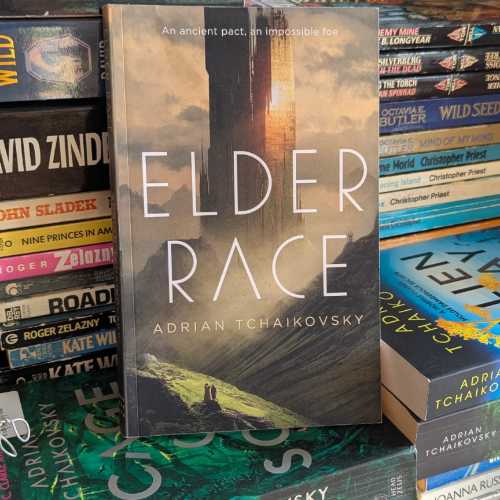
Elder Race
★★★★★
On a colony world, abandoned for a thousand years before its rediscovery, a stranded anthropologist named Nyr sleeps the centuries away, waiting forlornly for contact from Earth. The princess Lynesse, calling in an oath he once made to her ancestor, wakes him and entreats his aid.
Nyr tells his story from a technological point of view — he’s a scientist equipped with advanced tech and an upgraded body, but dealing with severe mental health issues as he faces the reality of being abandoned, the last of his kind. Lynesse’s chapters are pure fantasy — a brave princess enlisting the aid of a wizard in a heroic attempt to vanquish the demon ravaging her land.
The line between magic and technology has been explored before, but Tchaikovsky’s alternating chapters from these two distinct perspectives drive home the fact that reality is relative. How you see and interpret the world depends on your cultural referents and what hill you’re standing on.
A wonderful dynamic unfolds between the two where they’re fundamentally unable to communicate their truth — their words and actions are just reinterpreted by the other’s frame of reference. They share a common reality, while being isolated by their own perspectives.
On encountering the ‘demon’, they are both confronted with incomprehension. By undermining our tacit assumption that Nyr’s scientific view is the ‘correct’ perspective, it reinforces the fact that we’re always constrained by our model of the world, never seeing its true reality. Furthermore, Nyr’s depression, and his tug-of-war suppression of it with technology, act as an internal ‘demon’, showing that his mental state is as distorting as any cultural or technological frame of reference.
It’s a beautifully done exploration of this theme, while being wrapped around a smart high-stakes quest that’s a satisfying narrative in its own right. A novella that asks us to critique the anthropological ‘reality’ of our own colonial history — it’s well worth your time.