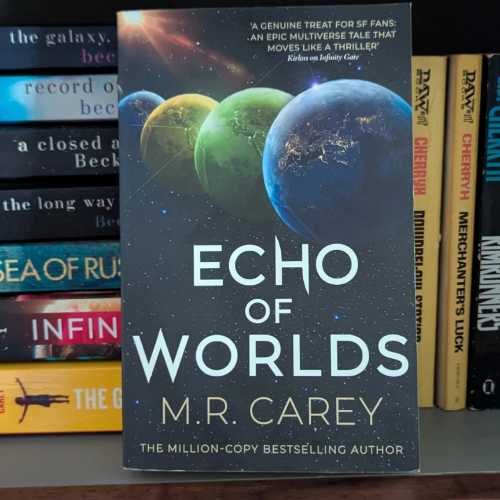
Echo of Worlds
★★★★★
Following the events of Infinity Gate, two multiversal empires are at war, with mutual annihilation imminent. The untethered AI Rupshe has assembled a motley crew in a last-ditch attempt to prevent doomsday weapons from being unleashed.
Carey remains grounded with a cast of relatable characters even as he thrills with extravagant big-screen action. The core conceit of an infinity of parallel Earths, only a step away, provides fertile ground for creativity as epic battles and heists range across this strange geography, reminiscent of the novel set pieces of Tenet.
As the countdown clock ticks, the team mounts a series of ever more ludicrous heists on the impregnable fortresses of the Pandominion, in service of a wing-and-a-prayer plan to entreat an isolationist godlike intelligence to neuter the war machines.
Occasionally, the fine slicing of the narrative into a staccato flip book of short pov chapters can be exhausting, but Carey manages to hold it together across the ensemble cast, keeping all their arcs moving along to satisfying conclusions. In particular, the gelling of the dysfunctional team into a found-family through their lived experience is done perfectly.
This is a classic high-octane space opera romp that sags slightly in the middle as it moves through a series of fetch quests without a clear narrative destination. However, the smooth prose doesn’t bog down, and as the tension escalates, the ending delivers an unexpected punch, satisfyingly wrapping up the duology.
Infinity Gate established strong thematic world-building — multiversal authoritarianism and colonialism, AI freedoms, the value of a single life in a literal post-scarcity infinity of lives. Echo of Worlds succeeds as a mission-oriented thriller rather than a deeper exploration of these ideas. But that’s fine with me. I highly recommend the series and look forward to reading more tales from the Pandominion.